...harvesting the cult of alter reading...


Search This Blog

Tuesday, November 20, 2012

CURTAILING FREEDOM OF SPEECH!!!

CURTAILING FREEDOM OF SPEECH!!!

Ratheesh Kaliyadan
Freedom of speech and expression is one of the important tenets of Indian constitution.The fundamental right is violated by the Maharashtra Police officials by arresting Shaheen Dhada for a simple reason. The reason is her pretty comment on the bandh in Maharashtra in connection with Bal Thakare's death and funneral function.The police's allegation is that she was hurting the religious sentiments. Thackare was a political leader who lead political struggles by utilising Maratta feelings. Then how does the comment hurt the religious sentiments. It is an innocent comment which will not fire even a small piece of paper. We do not understand the police men's stand. its a mere absurd to say that a comment on Hartal or Bandh posted in a social media which would be shared in friend's circle will harm the religious sentiments. The police action is considered to be the violation of the fundamental right to freedom of speech and expression.
People belong to different walks of life are marching their protest against the police action. They are supporting the young lady and become guardian of the fundamental right. The valuable comment of Markanteya Katju, the chairman of Press Council gets specia attention. He wrote:  "Under Article 19(1)(a) of our Constitution freedom of speech is a guaranteed fundamental right . We are living in a democracy, not a fascist dictatorship. In fact this arrest itself appears to be a criminal act since under sections 341 and 342 it is a crime to wrongfully arrest or wrongfully confine someone who has committed no crime" .
The police action is not an alienated incident. Let's see and experience similar occasions in various states. Those who are moving pen against the orthodoxy or the government policies are being tortured  in different ways. Invisible internal emergency is practiced here. At the same time media are not supporting the social causes. Knowingly or unknowingly they are also become part of official play grounds.

Friday, October 12, 2012

Delhi High Court’s proposed Guidelines for Media Reporting on children  

Mrinal Chatterjee


Delhi High Court in WP(Civil) No 787 of 2012 in Ananta Kumar Asthana Vs Union of India & others has approved Media Guidelines for children.
Media coverage on matters relating to children may have long term consequences on their overall development (physical, mental, psychological, emotional, moral, social, economic etc.) life and dignity, and lack of care by Media in this regard may entail real risk of children facing harm, stigma, disqualification, retribution etc. The privacy, dignity, physical and emotional development of children is of the utmost importance, which are to be preserved and protected at all times, while reporting/ broadcasting/ publication of news/programs/documentaries etc on and for children.

The Guidelines mentioned below are proposed in the backdrop of the existing legal framework to secure and protect the rights of children and set out the minimum parameters of responsibility for Media.

‘Child’ or ‘Children’ shall mean a person(s) who has /have not completed 18 years of age. ‘Media’ shall include but not be limited to any newspaper, magazine, news-sheet or electronic media.

Involvement of children in news/programs/documentaries etc must evidently be editorially justified from a child rights’ perspective.

Media shall ensure that child victims of rape, other sexual offences, trafficking, drug/substance abuse, elopement, organized crimes, children used in armed conflicts, children in conflict with law and child witnesses etc. are automatically guaranteed anonymity for life.

Media must ensure that due consideration is given to a child’s right to privacy and to prevent the child from being exposed to anxiety, distress, trauma, social stigma, risk to life & safety and further suffering in relation to reporting/ broadcasting/ publication of news/ programs/ documentaries etc on and for children.

Media shall ensure that a child’s identity is not revealed in any manner, including but not limited to, disclosure of personal information, photograph, school/ institution/ locality and information of the family including their residential/ official address.

Media shall not sensationalise issues or stories, especially those relating to children and should be conscious of the pernicious consequences of disclosing/ highlighting information in a sensational form and the harm it may cause to children.

While interviewing a child the Media should be governed by the following principles.

a) That the interview is in the child’s best interest

b) That the interview does not aggravate the child’s situation further.

c) That the manner and content of the interview doesn’t affect/interfere with the child’s right to privacy.

d) That if the interview is in the child’s best interest, the same shall be done under supervision and consent of the child’s parent(s) or legal guardian, or in the alternative, the competent authorities for the child.

e) That while interviewing a child, his/her consent may be obtained, depending upon his/her age and maturity.

f) Frequent interviewing of a child must be avoided.

g) The child’s refusal to be interviewed must be honoured.

h) Before interviewing the child he/she must be duly informed about the purpose and manner of the interview.

i) The child and/or his/her parents/guardian or any person having control over him/her shall not be coerced or enticed in any manner including financial or other inducement to secure consent for the interview.

Media must verify the credentials and authority of individuals/ organizations whose consent is sought on behalf of the child.

Media shall not give any financial or other inducement to the child or parent / guardian or others in relation to reporting/ broadcasting/ publication of news/ programs/documentaries etc. on and for children.

Media must balance its responsibility to protect children from unsuitable content with the right to freedom of expression and the right to know.

To protect the identity of the child media shall ensure that any visual showing the face of the child must be completely morphed in cases where privacy/anonymity is required.

Media shall orient/sensitize its editorial personnels, including editors/ editorial team / reporters / correspondents / producers / photographers etc. about laws, rules, regulations and guidelines related to reporting / broadcasting / publication of news/ programs / documentaries etc. on and for children.

The media shall proactively promote the children’s right to information and freedom of expression.

The compliance with the applicable laws, rules, regulations and guidelines related to reporting/ broadcasting/ publication of news/ programes/ documentaries etc. on and for children shall be monitored by a) the self regulatory bodies, b) the regulatory mechanisms of Ministry of Information and Broadcasting, such as Electronic media Monitoring Centre (EMMC) and Inter Ministerial Committee (IMC), Press Council of India through their respective procedures.

Wednesday, October 10, 2012

KUDUMBASREE AGITATION FAILS IN MARKET MEDIA MANAGEMENT MANTHRAS


KUDUMBASREE AGITATION FAILS IN MARKET MEDIA MANAGEMENT MANTHRAS

Ratheesh Kaliyadan
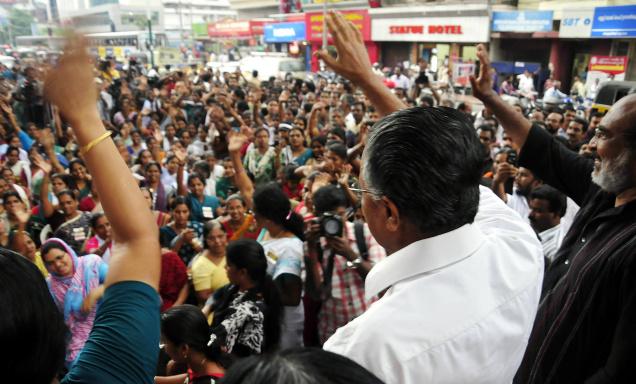
Kerala Government secretariat witnessed the powerful women agitation by Kudumbasree Mission activists. The week long agitation will be written as one of the prominent agitation lead by women in Kerala. It was a round clock dharna attended by over 2,000 women. The strike became the embodiment of womenfolk from all over Kerala.
CPI(M) State secretary Pinarayi Vijayan visits striking Kudumbasree workers in front of the Secretariat in Thiruvananthapuram on Monday. Photo: S. Mahinsha. Courtesy The Hindu.
Kudumbasree is a government sponsored self help group to enhance women empowerment in Kerala. Launched by the Govt. of Kerala in 1998 for wiping out poverty through community action under the guidances of Local Self Governments. Kudumbasree is one of the largest women empowering project in the country. The mission has 37 lakhs members who covers more than 50% of the households in Kerala. Women who belong to all political and religious affiliation join in Kudumbasree mission.
The immediate provocation behind the agitation was the government’s ignorance of the mission in allocating funds and the central and state government’s initiation to support Janasree Mission, a counterpart of Kudumbasree but organized privately by the India National Congress leader Mr. Hassan as the chairman. The political affiliation of this new organization saved a lot in grabbing government funds. The major motto for the indefinite strike is the withdrawal of Rs 14-crore fund sanctioned to the Congress-sponsored Janasree Mission under a centrally sponsored scheme. The workers, who began the strike in front of the Secretariat at Thiruvananthapuram on October 2.
The strike called off yesterday after they got assurance from the authority that Kudumbasree would be made the nodal agency for the Rashtriya Krishi Vikas Yojana. Home minister Thiruvanchor Radhakrishnan and panchayat minister M K Muneer held discussions with Left leaders.Though the Kudumbasree Action Council has been demanding the withdrawal of the fund, the government said that Union agriculture minister Sharad Pawar had sought an explanation on the allocation to Janasree. The government said it was waiting for the Centre's decision, and promised to act on its basis. Former minister Thomas Issac  and LDF convener Vaikkom Viswan led the Left delegation in the talks.
The matter of discussion in our  forum is the treatment style of the agitation by regional and national media. Knowingly or unknowingly most of the popular media in Kerala ignored the strike by providing small spaces in inner pages. Deshabhimani, the mouth organ of CPI(M)  is the only prominent Malayalam daily made the victory of women agitation as the lead story. Janayugam of CPI also ignored the story not providing front page space. The most interesting fact is the chairman of the strike supporting group is C.Divakaran, former minister and CPI leader.
The national media including The Hindu, which gives more space and sympathy towards women issues did not cover it with its emphasis. Even in the Thiruvananthapuram edition, a photo is not appeared in the front page. The news channels were not behind the agitators to copy the feel of Kerala women agitators.
Why do our media shift concentration from genuine issues? If a government is ready to sanction 14 crore rupees to a private agency ignoring the government organization will not be a matter of attention to media? To ignore such issues and indirectly support private ventures, which news value hesitate the newsmen to cover the item! Instead of pointing out these issues, our media strive behind silly matters and make big shots. Real issues are sidelined behind sensational reality shows sponsored by politicians and celebrities as the age old yellow journalists flew behind such comics. Sensational news makers are looking forward for corporate and government advertisements. The busy business policies rule out the consumers’ right to know reality and to be informed properly. This is not an old man’s etiquette on the contemporary journalists but a crucial ethical concern where traditional news values are vanishing and market decides what to be informed and thought.  

Sunday, August 5, 2012

VEENAPOOVU AT TELLICHERY

VEENA POOVU IN TELLICHERY

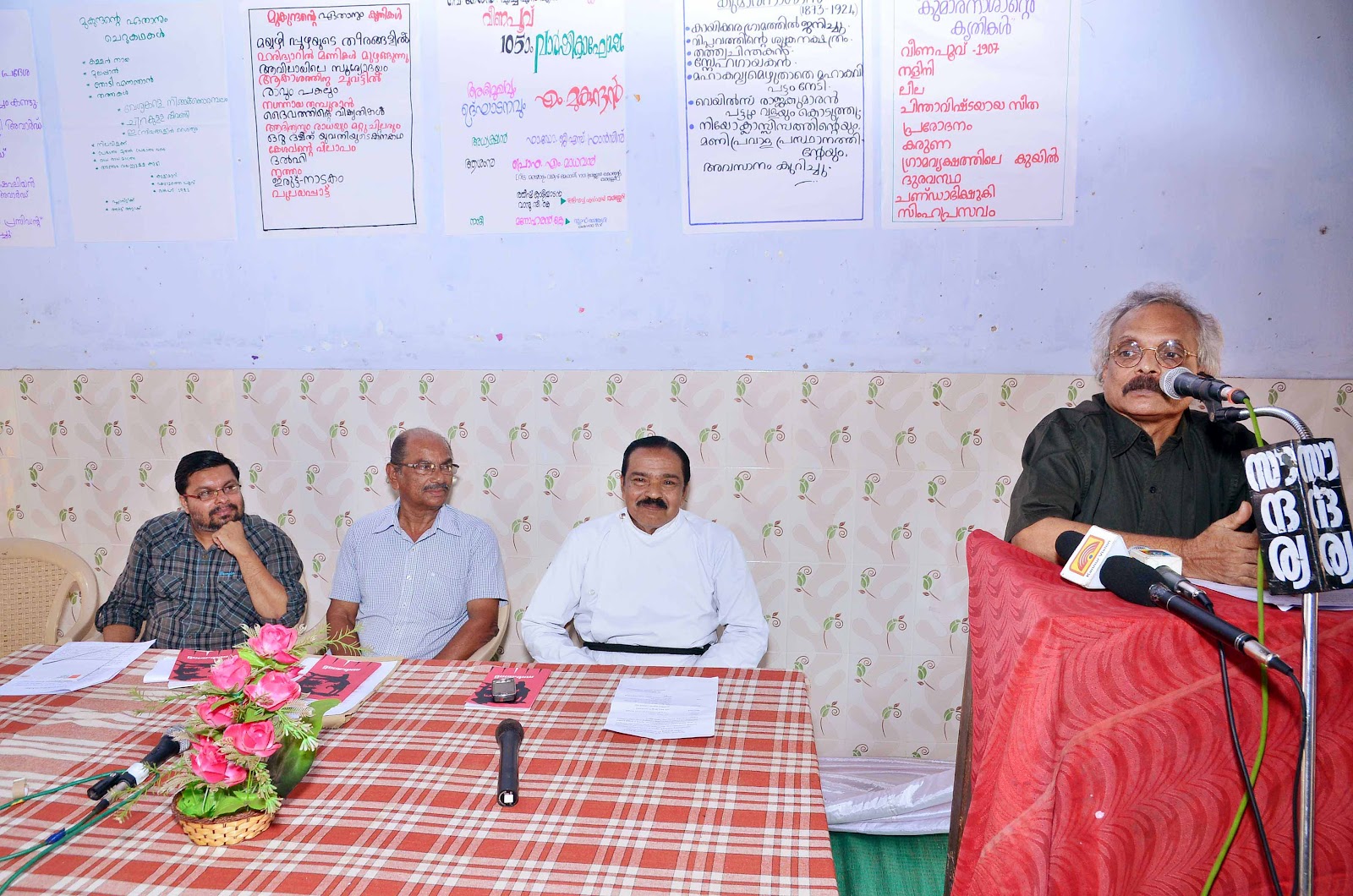
What is the relationship between Veenapoovu and Tellichery? The answer is simple: the celebrated poem Veenapoovu flowered in Tellichery. really! yah.. it was 105 years back. Kumaranasan's poem published at first in Mithavadi, a Tellichery based magazine edited by Moorkothu.
Government Girls higher secondary school celebrated the 105th yeras of publication of Veenapoovu at the school hall with the Marymatha Trust. noted novelist M.Mukundan inaugurated. Prof. M.Madhavan and Ratheesh Kaliyadan presented papers. Fr. dr. francis presided. C.K.Vasu and K. Manoharan extended welcome and vote of thanks respectively.

Tuesday, June 26, 2012

Communication Research in India: A Status Evaluation


Communication Research in India: A Status Evaluation


Prof. K. V. Nagaraj
Head,Department of Mass Communication,
Assam University, Silchar, Assam

Journalism education in India, for all practical purposes, is as old as independent India. Before Independence, the press with its obsession with political issues had little or no time to conduct even readership surveys. Circulation figures were the only source of information as to the readership. The departure of the British from India provided the press both challenges and opportunities. Industrialists took over the ownership of major newspaper groups and as a result journalism acquired the overtones of business profit and power were the twin motives behind these acquisitions. Not much importance was attached to readership research. On the other hand, the government owned All India Radio already had the listener survey or audience research unit that later paved the way for more expansive research into the field of broadcasting. Professional research organizations came into the scene only in 1970s. the ABC (Audit Bureau of Circulation) was perhaps the only source of circulation data considered authentic. Historically, academic research in journalism per se was not a phenomenon till 1970s. some research efforts in journalism could be seen in other social sciences, which were basically inter-disciplinary in nature, either in history or political science or English literature. In fact, many of the early teachers who took interest in teaching journalism were from the background of English literature.

With a steady process of Professionalisation, importance of journalism education was realized. However, as was in the United States and other western countries, the classroom-news conflict syndrome raised its head, and the working professionals often lampooned the theory loaded instruction in academic institutions. Unfortunately, most teachers in journalism were and are not from the profession and did not and do not have any professional experience. In the same vein, most professionals had learnt the skills by the trial and error method.

Unlike the West which had a flourishing media market linked to the industrial revolution, India started struggling to imitate the developing countries, attempting devise a middle road between two competing ideologies of capitalism and communism. Obviously, the media took, especially the print, in delight in the triggering of politico-economic blunder buss. The non-discriminate readership supinely accepted the political rhetoric provided by the new bread of journalist. The tradition still continues.

In the West, especially in the united states, the university-industry linkage is significant in the media sector professionals who have high academic qualification join universities and help develop research programmes. They also secure projects to produce high quality research output while the newsroom-classroom hiatus has narrowed down with the graduates in journalism hooding media houses and media houses in turn opting for campus recruitment, the two-way traffic is not happening professionals, except a few, do not have interest in academic programmes including research. For some, research seems to be a collection of information. (The National Knowledge Commission ) has bemoaned the quality of Ph.D.s churned out by Indian universities and suggested the production of Ph.D.s of more quality and quantity. The quality of Ph.D.s in journalism does not meet the rigorous parameters of international standards. Often the are products of ‘cut-and post’ business drawn from the Internet sources. Original research does take place, but here again the number of quality efforts are far and few. When it come to quantitative techniques and their application, it is merely duplication or multiplication of what has already been done. Even qualitative research is far from satisfactory. There exists an urgent need to train a dedicated band of researchers in universities.

In this context, we should also remember the industry investment in its own R and D as well as in academic institutions for research is abysmally low compared even to china. On the other, the media revolution in the form of television channel boom has prompted rating research, each channel vying for a higher TRP for its programmes than others. Obviously, several Indian and foreign players have entered the field. Among Indian organisations mention must be made of ORG (Operational Research Group), MARG, IMRB. A.C Nielsen has emerged a key player of late. However, most research organisations follow the technique of market research, different from media or communication research. Academic research in India as already mentioned is shoddy irrelevant and primitive. Imprecise application of methods and technique has been the scourge of academic research in communication.

Intermedia competition should encourage research in communication/ mass communication as it happened in the West Unfortunately. We are slow in catching up with them. The National Readership Surveys are a good effort, but do need the participation of more number of newspapers and magazines. The audience research units of both Doordarshan and All India can employ more sophisticated tools for better results. Though now under the control of an autonomous corporation, these units have to come out of the bureaucratic hung over.
At the application level, there should be a national debate on the relevance of western tools and techniques in the Indian context. Unlike many developed countries, the collection of primary data is not an easy task in India Social and other factors have made collection of date difficult. Most academic researchers depend upon secondary sources of information for their output. The logistics, accessibility and finance have been the main areas of deficiency for communication researchers in India. While science gobbles up a substantial chunk of government patronage, communication as a discipline is attached to social sciences get very little financial attention. The private investment in communication research is absolutely non-existent added to the inertia of most academics in government funded universities. The situation in private institutions disgustingly abominable. In reality, there exists no research tradition or culture in the field of mass communication in India.
The private –public participation (PPP) model has not taken off mainly due to the disinterestedness on both sides. The public institutions have framed such rigid rules that even the most enterprising academics back out when it comes to consultancy services including research. On their part, private media houses have very little faith in the quality of research work carried out in academic institution. It is disgusting to see many teachers in mass communication departments while away their time more in unproductive work than in research. The authorities should introduce an accountability clause that includes their research contributions that keeps on their toes. Added to the misery is the absence of peer reviewed research journals many a university department of mass communication makes a half-hearted beginning to float a journal and after a couple of issues, these journals make an unceremonious exit. In other countries, quality journals have survived unlike in India, we cannot boast of a single journal of standard let alone international. Some publications like the vidura and the grassroots so not strictly fall under the category of research journals.
It is also amusing to go through some of the research titles. No serious thought is given to the selection of the topics which appear mostly macro. The textual intervention of media history even in quantitative studies makes a mockery of the entire research process. For these reasons, institutions like the ICSSR should conduct workshops regularly on research methods to update and improve the knowledge level of young academicians and researchers. The establishment of a research institute the model of Institute of Socio-Economic change only for mass communication research can a feasible proposition. In the US Nieman fellowships are awarded to media professionals and others to do research on any subject of their choice without any strings attached. Similar arrangements can be thought of in India also. The prosperous media organisations can carmark a small portion of their profit for this purpose.
Advertising as persuasive communication, is a fertile area of research. The story is similar and it is left to the researchers in the management sector to take care of it. Neither copy research nor the design aspects have been researched upon. Advertising agencies do have research departments, but for other purposes, public Relations firms have not evinced much interest in research activities for reasons best known to them only Likewise the new media sector calls for meaningful research efforts. Other Asian countries like China, Korea, Malaysia, Singapore and Japan have made enormous strides in communication research, keeping India for behind. The Indian habits and impact studies shows only the duplication of efforts and their lackadaisical attitude towards the issue. The urgent need of the hour is to introduce professionalism in academic research in the field of communication. The inference drawn here do not mean that we have to simply ape the western concepts and methodologies of communication research. What is needed is an expansive development of Indian contribution to methods of investigation. We have a strong background in mathematics and statistic and should we not produce new formulas of evaluation? Even our attempts at historical research are inaccurate, incomplete and often biassed with personal affiliations, ideological or otherwise. Time is ripe for a rethink on the issue and a structural overhaul along with intensive intentions for a corrective course.
We can replicate the national knowledge network suggested by the National Knowledge Commission in its report submitted to the union government for a nation communication research network to connect media institutions, university department, research organisations and other professional institutions to create an environment of viable research. No doubt, the reming masses of young men and women will have innumerable opportunities knocking at their door.
References
  1. National Knowledge Commission Report, Government of India, 2009
  2. Mass Media Research: An introduction Roger D. Wimmer and Joseph R. Dominick
Courtesy: Mediamimamsa


Thursday, June 21, 2012

 MEDIA ZIGZAG WITH A LETTER

Media in Kerala recently made a new controversy over the celebrated Marxist economist Dr. Prabhat Patnaik's e-mail regarding a comment 'CPI (M) as a killer party'. Actually Dr. prabhat Patnaik didn't mention the party as a 'killer party'. At the sametime he criticised CPI(M)'s current position as "I see Communism in India today as being threatened in two ways: either being hegemonised by bourgeois liberalism, or as falling prey to a feudal-Stalinism."No media persons took a position to read the letter and reveal the reality. Instead they published what the "party enemies" handed over as a release. The objectivity and believability is once again challenged and questioned through the action. Dr. Prabhat made his comment to a letter mailed by K.T. Rammohan. Part of the misleading letter is given below.

KT Rammohan’s email:
…Prabhat, as I know, is one of the finest human beings in Indian academia, a brilliant economist, and well-worth a speaker in the proposed Ravi-meet. No qualms, we all agreed. But then there was history. I am sure that Prabhat is not a person who would justify the present killing. And now to have Prabhat (and that too to a place not far from Onchiyam), so closely identified as an intellectual of the killer-party, a government official during its earlier regime in power, would imply legitimising the murderous-party.
May be, it tvm were the venue, even now, I would not have expressed similar reservations in having prabhat. At Kozhikode, this would be the 52nd stab.
Please rethink! Prabhat could still be invited but if the theme could be changed to something like corporatism and social fascism in Malabar. 
…please feel free to forward this mail to all, including Prabhat.
Best regards,
Ram.

The highly subjective letter is not even provoked the left economist. He responded Mr. Rammmohan's latter gently. Dr. Prabhat reminded Mr.Ram about his background and deep routed connection with the CPI(M) also. At the sametime he put-forwarded his intellectual criticism also. Our media people didn't mind it. They also took part of the anti-communist campaign publicly.The so called impartial newspapers and television channels played the game cleanly. They displayed their 'exclusive' scoops and stories with maximum importance. Here is the letter by Prabhat.

Prabhat Patnaik’s Response to Rammohan's mail:
Dear Ram,
I appreciate the point made by you in your mail, and wish to say the following in that connection.
I have been with the Party for 37 years, having joined it at the start of the Emergency. My father had been a freedom-fighter and an early Communist (he was a founder of the Communist Party in Orissa in 1936). Having seen in my childhood the enormous sacrifices the Communists made, and the dedication to the cause of the working people that they had, it had always been my ambition to join the Party which was finally realized in 1975. For this very reason however the developments in Kerala over the last several days have been a source of great pain and anguish for me. The problems they pose for me are not just moral but also existential.
I see Communism in India today as being threatened in two ways: either being hegemonised by bourgeois liberalism, or as falling prey to a feudal-Stalinism. What is common to both these trends is an implicit lack of conviction about socialism, an implicit subscription to the neo-liberal “development” agenda, and an implicit denial of scope for people’s empowerment. Succumbing to either or both these threats would be disastrous and totally against the interests of the people. If socialism is to be brought back on the agenda, then an alternative de-Stalinized Marxism has to be practiced. I was looking forward to the Chintha Ravi Memorial seminar as an occasion to discuss these issues, and hence to critique the feudal-Stalinist trend that one encounters in Kerala, and also elsewhere. I saw the seminar as such an occasion because I knew that it would be attended by intellectuals seriously interested in Marxism. I do not often get an opportunity to interact with such a group.
One final point. The official position occupied by me in Kerala under the last government was not out of any Party mandate but at the personal request of Com. V.S. Achuthanandan. Most of my friends, including in the Party, advised me against it, but I took it up nonetheless, and have never regretted that decision.
With regards,
Prabhat Patnaik
 

Wednesday, May 2, 2012

India Beats for Media Literacy


India beats for Media Literacy

Ratheesh Kaliyadan
Most of our children abounded with media messages emerged  from newspapers, magazines, TV, Radio and from the new media. The affluent flow of messages influences their life from various directions. Media syndrome is a major issue of city folk and even in villages, though the intensity is lesser. Increased exposure to the media is associated with multi-faceted problems like increasing obesity, body dissatisfaction, aggressive behavior and many more amongst Indian children. They are growing fast mentally and physically whom psychologists are termed now as  ‘The New Kid’. It is pathetic to realize that our children are not treated by the media world considerably. India has least number of kids channels. Out of total only 3 percent of channels are kids’ channels ( 17). In a country which has 550 TV channels, 77,600 newspaper types in multiple language, 595 movie releases ( including Hindi, regional and Hollywood releases) and so many FM channels have we ever wondered what space have we given in a such a wide canvas to our children. According to FICCI-KPMG Indian Media and Entertainment Industry Report 2011 “Hitting the High Notes” the Indian media and entertainment industry grew from INR 587 billion in 2009 to INR 652 billion in 2010. The growth is registering an overall growth of 11 percent. The industry includes TV, Radio Print, cinema and gaming. The educational and entertainment needs of a very vast population i.e. children is disregarded in this race.
 The kids’ genres of channels are not offering much better performance is yet another reality which we face. The children watch programmes produced for Adults. The reality shows, the soap operas, the highly sensualized news stories are definitely not meant for children. But they anyhow are watching them with great interest. In such an environment, there is a wider chance to implement media literacy programmes in schooldays. Children reach school at the age of 5 in India. Curricular and co-curricular experiments are possible in India environment. Sophisticated media consumers and the fact that they experience so many medium at home would seem to be as a good reason to include it in the curriculum than to exclude it. At national level, Central Institute for Education and Training, NCERT, New Delhi began an effort to make media literacy campaign. Their target audience is the secondary and senior secondary students. The institute started Media clubs in schools.
Government of Kerala introduced journalism course in Higher Secondary Schools is the first attempt in India to consider at a large. The course introduced in August 2000.  Higher Secondary Education began the course in seven schools, now the course runs in 75 schools. The growth indicates the social demand for the course. The major drawback of the curriculum is that it does not cover the critical thinking. If the curriculum is revisited in a style, which promotes critical analysis of the media sector, the effort will be the first one in India media education history at school level.
Non- Governmental Organisations like Mediaact in Thiruvananthapuram and Media Analysis and Research Center in Kozhikode tried their own efforts in media literacy sector in Kerala. These are not well framed and organized forms of activities. Lack of closely knitted curricula and research oriented documents pull back such efforts from the mainstream.